Restoring Faith in Democracy through Storytelling

Restoring Faith in Democracy through Storytelling

The key to saving our democracy is to restore our faith in it,
and storytelling is how we will do so.

Lessons from directing Heidi Schreck’s What the Constitution Means to Me

By Emma Cahoon

In What the Constitution Means to Me, playwright Heidi Schreck revisits her days competing in American Legion Oratorical Contests to explore the inseparability of our personal histories and our national history. She looks back into her own past, the pasts of the generations of women that have preceded her, and into the past of this governing document and its many refractions throughout time. Heidi Schreck wrote this play in 2017, and it premiered on Broadway in 2019; pre-COVID, pre-George Floyd, pre-January 6, pre-Dobbs, pre-2024 election, and everything that has followed.

When I sat down in front of this play after signing on to direct it at the end of last summer, I was captured by the friction of how different our current landscape is from just eight years ago when Heidi wrote it. I worried that our Constitution and the Democracy it seeks to uphold are losing their meaning by the minute, and I struggled to develop a sense of direction for the play. 

As we charge forward into the 250th anniversary of our country’s independence, we are confronted daily with a barrage of horrors that make many of us want to turn our hearts and minds away from the notion of a “democracy” that has rejected us and those we love. Taking an honest look at both the moment we are living through and the moments that have led us to it reveals a cracked foundation and a seemingly endless sea of false promises. Many of us no longer use the word “our” in reference to this country, because at some point, we realized we were not included in the preamble’s “We.” How can a person believe in something that never believed in them? 

Most of us, across any cultural, social, or political spectrum, can agree, however, that we are facing a crisis of polarization. Extremists in all directions have heightened the stakes and killed compromise, denying nuance, listening, and conversation. Division is encouraged, and we find ourselves crawling into corners of discourse that quickly become echo chambers. The extremists in the opposite cave have never seemed more different from us, and it requires effort to keep their inflated rhetoric at bay. Our impulse in every relationship we maintain, every piece of media we consume, and every choice we make, is to seek those who affirm what we already believe to be true. This leaves no room for curiosity and little air for empathy- two key ingredients for creating cogent and stimulating change, and also for live theatre. 

In truth, I struggled with this friction even as we began our rehearsal process. I had questions about how the play works in the year 2025 that I hadn’t even formed hypothetical answers to before our first readthrough. Sitting in front of the text, I realized that in order to unlock this play for myself, I needed to do the same thing Heidi sets out to do in it: to rediscover some faith in our democracy. After all, the loss of faith in our democracy might be part of what is killing it. Democracy, I realized, is like Tinker Bell; we must clap for her when she is on her deathbed, for every time you say you don’t believe in them, a fairy dies somewhere.

Now, my question was this: How do we get ourselves back to believing? How can we clap for a system that is clearly failing us? What is the “faith, trust, and pixie dust” of modern America?

Life interrupted my momentum; the very same week that we began rehearsing, my own great-grandmother, Lois, passed away at age 99. Her memorial services were held during our third week of rehearsals. The night before the funeral, I dove for hours into her large collection of genealogical research, absorbing generations-worth of family history as the Patriots beat the Dolphins in the background. In book titled “Our Family Tree,” I read the story of my ancestors’ immigration to America, written in my great-grandmother’s cursive script:

“Agnes Rylander was the oldest child of a church bellringer- a church worker who ran the school and the other secular activities. They lived next to the church. When she was sixteen, she went to live with her aunt, her father’s sister, whose only child, a son, died in infancy. She was educated as a daughter of a large property owner, learning fancy embroidery and music. She had a baby grand piano with her name on an engraved brass plaque at Trädet. Agnes fell in love with one of the workers, Wilgot Josefson, and went to America to join him two months after he immigrated to New York in 1885. They were married on her eighteenth birthday. He took the name Sanden. The Sandens lived in Mill Plains, Connecticut when daughter, Nellie was born in 1891. Agnes took Nellie to Sweden in 1896. They visited the Rylanders for a year. Nellie celebrated her sixth birthday at Trädet, the place where her parents fell in love, before coming back home to America.” 

(My personal amendment to the story is this: Nellie bore a daughter named Lois, who bore a daughter named Cynthia, who bore a son named Matthew, who married a woman named Carey, and together, they had a daughter- me!)

This was the earliest story written in the book, and each subsequent tale documented on the pages in front of me revealed many more patterns in my family’s history than I had realized were there. In every generation, my ancestors have been devotees of education, artists, lovers of community, skeptics of money, believers in democracy, teachers, readers, travelers, deep appreciators of nature. I began to realize that nothing about who I am is an accident, and there it was, deep inside me- the fairy-like flutter of belief in something larger than myself. 

So here, in an unexpected but ultimately very predictable place, was my answer. The secret ingredient to restoring our faith, the “pixie dust” to keep our freedom afloat- it’s stories. 

Stories are incredibly powerful. We know this because we fear misinformation, misinterpretation, misuse of narrative, misrepresentation of our character or intention. Stories have the power to help us imagine new possibilities. They allow us to see ourselves within something and to believe that we, too, are worthy of adventure, joy, ambition, success, love, triumph, and resolution. Stories allow us to realize that we are a part of something larger than ourselves. Stories can remind us of the legacies of historic events and the ripples of tiny, ordinary moments that have made us who we are today. 

To be an American is to have been raised with a shared set of standard stories, and therefore, the same ultimate set of core values that have unified our citizenship across time: life, liberty, and the pursuit of happiness. I may interpret the history and intentions of the Constitution differently from my neighbor, but the stories of all the various ways our Constitution has been used remind us that the facts on paper can contain a multitude of narratives. Stories illuminate the white space around the black ink on the page, remind us to constantly reinterpret, and encourage us to proudly reclaim.

Like democracy, storytelling is not a casual pastime; it is a necessity, an essential framework to our existence. This is put best by the great Audre Lorde in her 1985 essay “Poetry is Not a Luxury”: 

“For within structures defined by profit, by linear power, by institutional dehumanization, our feelings were not meant to survive. Kept around as unavoidable adjuncts or pleasant pastimes, feelings were meant to kneel to thought as we were meant to kneel to men. But women have survived. As poets. And there are no new pains. We have felt them all already. We have hidden that fact in the same place where we have hidden our power. They lie in our dreams, and it is our dreams that point the way to freedom. They are made realizable through our poems that give us the strength and courage to see, to feel, to speak, and to dare.”

Storytelling is necessary for liberation because, as Lorde points out, stories unlock our desires and open us up to imagining new pathways towards freedom. To be a citizen of a democracy grants you two gifts- it grants you a set of rights, but it also imparts upon you a set of responsibilities, too. What if we begin to look at speaking our truths and sharing our stories not just as our right, but as our responsibility?

Your fathers’ and uncles’ stories from the battlefield, stories of defending democracy, are necessary, even if you have different ideas of what that democracy should look like. They are necessary because there is value in passing down stories of people fighting for what they believed in. Your grandfathers’ stories of his father’s immigration to this country are important because they remind those who came after that we are where we are for a reason; that we are a part of a whole. The story of your elementary school field trip to Plymouth Rock, with all of the amendments and reinterpretations you have retroactively colored it with over time, is valuable because of what the memory has continued to teach you through its many evolutions. The story of the time you tried to recreate your grandmother’s apple pie but mistook salt for sugar is essential, because maybe just the memory of how the original tasted will provide comfort (another necessary tool). Maybe it will remind you of how much she loved you, and how she believed, wholeheartedly, in a better life for you than the one she’d had. She told you stories of her life to instill in you the belief in a better one, and those stories are why you take to the streets now and demand it. It is necessary to tell someone you love a story about the kindness of a neighbor, and then, in return for said kindness, to tell your neighbor a story about someone you love. These stories keep us from forgetting how to be kind and how to love.

We have to be willing to participate; to bravely take a step back towards the democracy and the history that have tried to shut us out; to recognize the malleability of the moment we are living in and choose to shape it rather than watch it be shaped. We might live in a healthier democracy if we think of each other not as opponents on opposite sides of extremist funhouse mirrors of truth, but as potential tellers of stories. I think Schreck believes this, too, given that she never refers to the writers of our governing document as the “founders,” but only as the “framers.” We must prove to each other that we believe in one another, and together, share stories that rouse belief like thunderous applause loud enough for the fairy-magic of democracy to be revived. 

Stories are the wind beneath the wings of where we’ve come from, who we are, and what we will become. What the Constitution Means to Me demonstrates this to be true of both our personal and national narratives, and my great-grandmother’s handwritten personal storybooks prove it, too. The storyteller in each of us is the part of us with complete agency; the storyteller is the part of us with the power to chart our own path; the storyteller within us is free and believes in freedom. That belief is what keeps the embers of this freedom alive.


Q&A with Cast Members of The Best We Could (a family tragedy) by Emily Feldman

Q&A with Cast Members of The Best We Could (a family tragedy) by Emily Feldman

The third and final Mainstage Production of theatre KAPOW’s 17th season is just a week away! The Best We Could (a family tragedy) by Emily Feldman continues our theme of Conversation as we ride along with Lou and Ella, father and daughter, as they drive across the country to pick up Lou’s new dog. Guided by a narrator called Maps and interspersed with memories and phone calls from Ella’s mother, Peg, their journey reveals hard truths as their pasts slowly rise to the surface. Theatre KAPOW’s production of this debut play is it’s New Hampshire Premiere. 

Actors Alex Picard (Peg) and Samantha Griffin (Maps), both making their tKAPOW Mainstage debuts, shared some insight into the rehearsal process and the play. 

Q: Are there particular themes in the play that resonate deeply with you? What can you not get enough of exploring in the rehearsal room? 

Alex Picard (AP): The idea that we are all just doing the best we can is something I think we can all find some resonance with. We’re pulled in so many directions – work, home, family and friends that it’s difficult even to find time to ourselves nevermind to take care of ourselves. That’s something I hear in my head every day.  I’m doing the best I can.  Sometimes we are.  Sometimes we’re not.  But in the end it’s all we can do.  

Samantha Griffin (SG): Something especially exciting we get to explore in the room is the transfer of knowledge through time, and as this play is presented non-linearly, it’s really interesting to track when people find things out, and how that affects conversations when the audience still doesn’t have all the information. 

Q: What role does movement and physical exploration play in the rehearsal room and in the production?

SG: theatre KAPOW in general always makes a point of playing with physicality and movement, even in pieces that aren’t scripted to include those elements. We always start rehearsal with a physical activity or game, and that helps inform us as actors that it’s okay to use movement and explore throughout the rehearsal. 

AP: Movement and physical exploration has been critical in the development of the world of the play, characters, and how they physically relate to each other. I love working physically with character and finding the things that make Peg, Peg helps me to lean into her and her family more effectively as everyone in the cast is working similarly. We never leave the performance, though we do leave the scene and finding how we relate to the action as well as our need to move to the next place/person/moment is the bulk of our work. 

Q: Has your experience working on this play or collaborating with theatre KAPOW offered anything distinctive compared to your previous work as an actor?

SG: I’m always struck by how collaborative the room is when working with tKAPOW. There are the designated roles of director, stage manager, and actor, but in a lot of ways we are all contributing to the overall picture of the piece. In this play especially, I think there are moments where each of us could say “that came from me”, and that’s really special. KAPOW’s model is pretty rare, especially in NH, and I think that’s part of what makes their work so unique. 

AP: I’ve worked a lot in a lot of different places and one thing I see at KAPOW that I didn’t always see in other theatres or with other companies is the careful attention they pay to the emotional, physical, and mental wellness of their cast and crew.  It’s deeply appreciated. I feel cared for on and off stage. 

Q: Is there anything else you’d like to share about this play or process?

AP: I love how Emily Feldman built this world.  It’s structurally very interesting and her use of repetition is very powerful. Her characters are flawed and human and try so hard. Sometimes they gain ground, but more often than not, they’re just working with everything they’ve got not to slide back instead. 

SG: Life has both light and dark, and so does this play. I hope you can join us in finding the beauty and humanity in each. 

—-

THE BEST WE COULD (A FAMILY TRAGEDY) BY EMILY FELDMAN performs at BNH Stage in Concord June 13-15th. Tickets are available online now!: https://ccanh.my.salesforce-sites.com/ticket/#/events/a0SUT000000HOqj2AG

“I’m going to ask you to be…”: Every Brilliant Thing, from the Audience’s Perspective

“I’m going to ask you to be…”: Every Brilliant Thing, from the Audience’s Perspective

theatre KAPOW has always aimed to bring the audience as close to the action as possible. In the company’s 17 year history, no play has ever done that quite like Every Brilliant Thing, which entirely relies on the audience to tell the story, inviting audience members to use their bodies and their voices to contribute to the play itself.

Longtime audience member and friend of tKAPOW, Eric Gutterson, has been visiting the Every Brilliant Thing rehearsal room throughout the process to play “test audience” and help the company experiment with the play’s audience participation. Eric provided some insight about this experience, and about what makes Every Brilliant Thing particularly special. Read Eric’s thoughts on the play and process below:

Q: How is the audience experience for Every Brilliant Thing unique from other plays?  

A: The obvious answer is that the audience can be more involved- become a part of the story. Being involved as an audience member might only be expected at an event like a magic show, illusionist, hypnotist, etc. The typical expectation as an audience member at a play is that you attend, find your seat, watch the show from a third-person perspective, and that is the full scope of the experience. Every Brilliant Thing welcomes willing participants into the story. One audience member might recite a Brilliant Thing out of a list of very many things. Or to a greater extent, one might take on a character, a person in the narrator’s life. The relationship with the actor is more intimate – they see you, they listen to what you have to say, and the interaction becomes part of the show.

Q: What feelings does the play evoke for you as an audience member?

A: Laughter, sadness, joy, longing, and a sense of togetherness. There is a sense of community between the actor, audience, and everyone in the building. Also, the play doesn’t shy away from being real. There are dark tones, but you come up for air early and often with frequent moments of comic relief.

Q: What has your experience been like in the rehearsal process and being a part of helping the team develop the piece? 

A: The rehearsal process has been a lot of fun. It has required careful consideration and respect for the audience, and for the level of engagement each individual might be comfortable with on show night. It feels like each moment is tailored with this in mind. The actor is faced with a constant challenge of not knowing what an audience member might do. When being a “guest audience member”, my goal has been to present several possible audience responses, sometimes ordinary, sometimes a little crazy. The play requires keen improvisation from the actor, which might be my favorite thing ever, because it can bring about hilarious, unexpected, unique scenarios that you’ll only experience once. I’m excited to see how it all comes together.

EVERY BRILLIANT THING
By Duncan Macmillan with Jonny Donahoe

February 7-9, 2025
BNH Stage in Concord, NH

February 21-23rd, 2025
Winnipesaukee Playhouse in Meredith, NH

Tickets & more information: www.tkapow.com/productions/#brilliant

*ASL Interpretation will be available on 2/9. 

**Live music by local musicians begins 30 minutes prior to each performance. 

#image_title
Unique, Beautiful, Thrilling and Terrifying: A Conversation on Every Brilliant Thing with Director Emma Cahoon

Unique, Beautiful, Thrilling and Terrifying: A Conversation on Every Brilliant Thing with Director Emma Cahoon

Theatre KAPOW’s second mainstage production, Every Brilliant Thing by Duncan Macmillan with Jonny Donahoe, is well underway! Having started rehearsals a month ago, director Emma Cahoon and actors Peter Josephson and Carey Cahoon have been hard at work  unpacking the puzzle as the performance dates approach. 

Emma Cahoon is a theatre-maker dedicated to the art of asking questions. A graduate of Boston University with a BFA in Theatre Arts, Emma has worked with organizations across the country including Central Square Theater, What Would the Neighbors Say?, the Seven Devils New Play Foundry, and more. Emma is very grateful to be working with theatre KAPOW again, with her previous directing credits including A Midsummer Night’s Dream for St. Anselm College’s Shakespeare on the Green and performance credits including Life Sucks. (Sonia), The Penelopiad (Maid), and Translations (Sarah). Emma’s directing practice centers elevating and exploring dramatic texts to their fullest depths, while building collaborative environments built on equal parts creativity, joy, and rigor, and working on Every Brilliant Thing has been a challenge and a joy for her.

Emma shared a bit about the unique experience of rehearsing this particular play and what she hopes audiences will get from it. Read the conversation below!

Q: How is Every Brilliant Thing unique from other plays you’ve worked on?

A: Every Brilliant Thing is a one person play, but it can’t be done alone because it relies heavily on audience participation. So there’s a script, but it can never be repeated exactly the same way. With two actors performing the play on alternating nights and an entirely different audience each time, every single performance will be different. It really takes the magic of the live theatre to the next level. It’s my feeling that every play should feel not just like a thing to be witnessed, but like a communal event. With this play, evoking that feeling is necessary. Every Brilliant Thing tells the story of a person grappling with their mother’s depression, and about the endless search for what makes this life worth living. So often, the answer to that question comes down to the people around us. That’s what Macmillan is reminding us by requiring the audience to be a part of the story; the only way through is together. So not only is the content of the piece unique and beautiful, but so is the way the story is told- in the round, with the house lights up throughout, and with the audience actively participating in the storytelling.

Q: What are some challenges and opportunities that this piece presents to a director and creative team? 

A: Rehearsing and staging a one person play presents its own challenges, as does staging in the round. I’m constantly looking for ways to make sure everyone can see and hear the actor without creating repetitive stage pictures. But our biggest challenge and our biggest opportunity is with the audience participation. What the audience will say or do or be willing to engage in is one giant variable we can’t control- it’s thrilling and terrifying! So much magic will be made in real time, surprising both the audience and the actor at the same instant. The caveat there is, of course, that we can’t plan it ahead of time. Peter and Carey and I are all artists who like plans- I like to be very specific with my staging and pacing, and Peter and Carey are typically actors who like to know what it is they are doing in every moment of a play so that they can surrender to the present when performing it. That sort of forward planning is not an option here. So our rehearsal process has been more of an investigation of what variables we can control and what possibilities lie within the variables we have no control over at all. I’m sure the audience will surprise us every night, and as terrifying as it is, I can’t wait to watch it happen. 

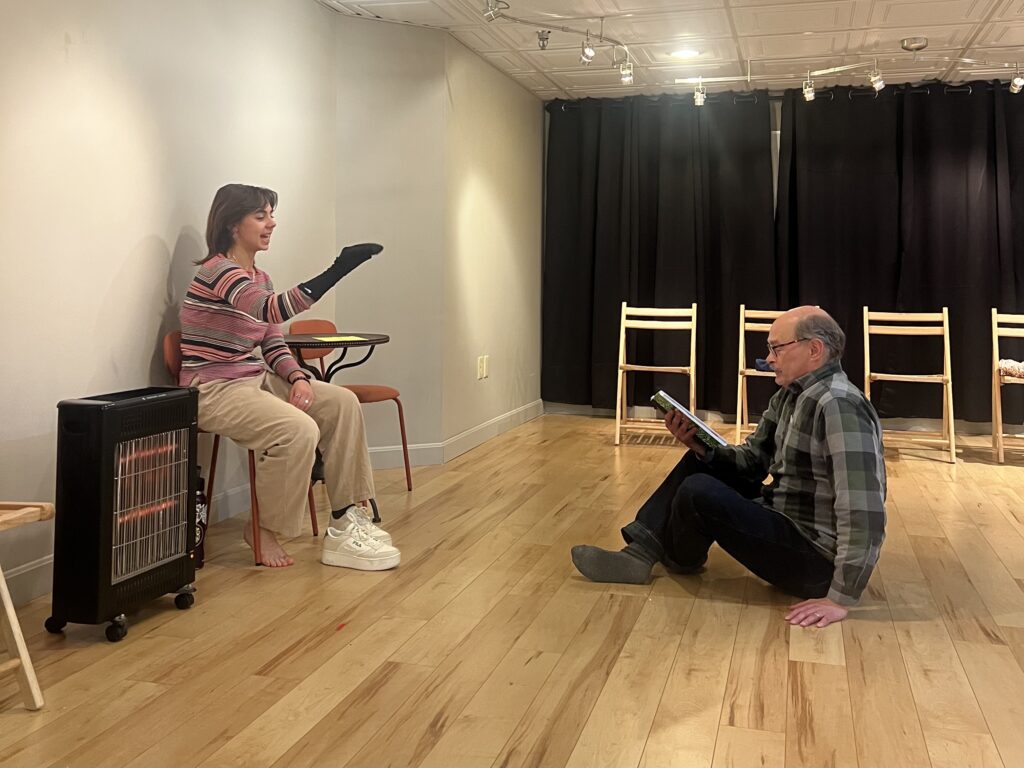
Peter Josephson (right) in rehearsal with guest audience member Cecilia Lomanno (left).

Q: What has the rehearsal process been like as you work through this piece? 

A: I knew early on that we would need to invite guests into the rehearsal room to experiment with the audience participation. We’re a month into the process now and we’ve had at least one test audience guest at every single rehearsal, and that has been immensely valuable. I can’t imagine rehearsing it any other way- otherwise I’d be running around the room playing 60 people while also trying to direct, and for obvious reasons that would not have worked. I’m so grateful to the guests who have lent their time, energy and their brilliant minds to our rehearsal room so we can figure out how to provide some loose shape to each of the audience’s participatory moments. It’s also been fascinating to work with both Peter and Carey, who are two very different actors. Their approaches to the text are unique from each other, and while they have been learning so much from the other in rehearsal, we are finding two very different versions of the same play. That’s been an interesting part of the process as well. 

Q: What do you hope the audience gets out of the experience?

A: I hope that this play reminds our audiences of how important it is to hold each other. How important it is to really look at, really listen to, really be with someone. So much about our current world is so isolating. Most of us spend our time looking down at screens, and oftentimes looking up at what is going on around us is utterly overwhelming. But I think that these kinds of communal experiences, and the ability to really be in conversation with each other, are going to be essential for us in the coming years. I hope that audiences come to Every Brilliant Thing and remember that brilliant things are everywhere. Reasons to stay are everywhere. And if you’re having trouble seeing them, maybe start by looking to the people sitting right next to you. 

EVERY BRILLIANT THING
By Duncan Macmillan with Jonny Donahoe

February 7-9, 2025
BNH Stage in Concord, NH

February 21-23rd, 2025
Winnipesaukee Playhouse in Meredith, NH

Tickets & more information: www.tkapow.com/productions/#brilliant

*ASL Interpretation will be available on 2/9. 

**Live music by local musicians begins 30 minutes prior to each performance. 

#image_title
Skip to content