Restoring Faith in Democracy through Storytelling

Restoring Faith in Democracy through Storytelling

The key to saving our democracy is to restore our faith in it,
and storytelling is how we will do so.

Lessons from directing Heidi Schreck’s What the Constitution Means to Me

By Emma Cahoon

In What the Constitution Means to Me, playwright Heidi Schreck revisits her days competing in American Legion Oratorical Contests to explore the inseparability of our personal histories and our national history. She looks back into her own past, the pasts of the generations of women that have preceded her, and into the past of this governing document and its many refractions throughout time. Heidi Schreck wrote this play in 2017, and it premiered on Broadway in 2019; pre-COVID, pre-George Floyd, pre-January 6, pre-Dobbs, pre-2024 election, and everything that has followed.

When I sat down in front of this play after signing on to direct it at the end of last summer, I was captured by the friction of how different our current landscape is from just eight years ago when Heidi wrote it. I worried that our Constitution and the Democracy it seeks to uphold are losing their meaning by the minute, and I struggled to develop a sense of direction for the play. 

As we charge forward into the 250th anniversary of our country’s independence, we are confronted daily with a barrage of horrors that make many of us want to turn our hearts and minds away from the notion of a “democracy” that has rejected us and those we love. Taking an honest look at both the moment we are living through and the moments that have led us to it reveals a cracked foundation and a seemingly endless sea of false promises. Many of us no longer use the word “our” in reference to this country, because at some point, we realized we were not included in the preamble’s “We.” How can a person believe in something that never believed in them? 

Most of us, across any cultural, social, or political spectrum, can agree, however, that we are facing a crisis of polarization. Extremists in all directions have heightened the stakes and killed compromise, denying nuance, listening, and conversation. Division is encouraged, and we find ourselves crawling into corners of discourse that quickly become echo chambers. The extremists in the opposite cave have never seemed more different from us, and it requires effort to keep their inflated rhetoric at bay. Our impulse in every relationship we maintain, every piece of media we consume, and every choice we make, is to seek those who affirm what we already believe to be true. This leaves no room for curiosity and little air for empathy- two key ingredients for creating cogent and stimulating change, and also for live theatre. 

In truth, I struggled with this friction even as we began our rehearsal process. I had questions about how the play works in the year 2025 that I hadn’t even formed hypothetical answers to before our first readthrough. Sitting in front of the text, I realized that in order to unlock this play for myself, I needed to do the same thing Heidi sets out to do in it: to rediscover some faith in our democracy. After all, the loss of faith in our democracy might be part of what is killing it. Democracy, I realized, is like Tinker Bell; we must clap for her when she is on her deathbed, for every time you say you don’t believe in them, a fairy dies somewhere.

Now, my question was this: How do we get ourselves back to believing? How can we clap for a system that is clearly failing us? What is the “faith, trust, and pixie dust” of modern America?

Life interrupted my momentum; the very same week that we began rehearsing, my own great-grandmother, Lois, passed away at age 99. Her memorial services were held during our third week of rehearsals. The night before the funeral, I dove for hours into her large collection of genealogical research, absorbing generations-worth of family history as the Patriots beat the Dolphins in the background. In book titled “Our Family Tree,” I read the story of my ancestors’ immigration to America, written in my great-grandmother’s cursive script:

“Agnes Rylander was the oldest child of a church bellringer- a church worker who ran the school and the other secular activities. They lived next to the church. When she was sixteen, she went to live with her aunt, her father’s sister, whose only child, a son, died in infancy. She was educated as a daughter of a large property owner, learning fancy embroidery and music. She had a baby grand piano with her name on an engraved brass plaque at Trädet. Agnes fell in love with one of the workers, Wilgot Josefson, and went to America to join him two months after he immigrated to New York in 1885. They were married on her eighteenth birthday. He took the name Sanden. The Sandens lived in Mill Plains, Connecticut when daughter, Nellie was born in 1891. Agnes took Nellie to Sweden in 1896. They visited the Rylanders for a year. Nellie celebrated her sixth birthday at Trädet, the place where her parents fell in love, before coming back home to America.” 

(My personal amendment to the story is this: Nellie bore a daughter named Lois, who bore a daughter named Cynthia, who bore a son named Matthew, who married a woman named Carey, and together, they had a daughter- me!)

This was the earliest story written in the book, and each subsequent tale documented on the pages in front of me revealed many more patterns in my family’s history than I had realized were there. In every generation, my ancestors have been devotees of education, artists, lovers of community, skeptics of money, believers in democracy, teachers, readers, travelers, deep appreciators of nature. I began to realize that nothing about who I am is an accident, and there it was, deep inside me- the fairy-like flutter of belief in something larger than myself. 

So here, in an unexpected but ultimately very predictable place, was my answer. The secret ingredient to restoring our faith, the “pixie dust” to keep our freedom afloat- it’s stories. 

Stories are incredibly powerful. We know this because we fear misinformation, misinterpretation, misuse of narrative, misrepresentation of our character or intention. Stories have the power to help us imagine new possibilities. They allow us to see ourselves within something and to believe that we, too, are worthy of adventure, joy, ambition, success, love, triumph, and resolution. Stories allow us to realize that we are a part of something larger than ourselves. Stories can remind us of the legacies of historic events and the ripples of tiny, ordinary moments that have made us who we are today. 

To be an American is to have been raised with a shared set of standard stories, and therefore, the same ultimate set of core values that have unified our citizenship across time: life, liberty, and the pursuit of happiness. I may interpret the history and intentions of the Constitution differently from my neighbor, but the stories of all the various ways our Constitution has been used remind us that the facts on paper can contain a multitude of narratives. Stories illuminate the white space around the black ink on the page, remind us to constantly reinterpret, and encourage us to proudly reclaim.

Like democracy, storytelling is not a casual pastime; it is a necessity, an essential framework to our existence. This is put best by the great Audre Lorde in her 1985 essay “Poetry is Not a Luxury”: 

“For within structures defined by profit, by linear power, by institutional dehumanization, our feelings were not meant to survive. Kept around as unavoidable adjuncts or pleasant pastimes, feelings were meant to kneel to thought as we were meant to kneel to men. But women have survived. As poets. And there are no new pains. We have felt them all already. We have hidden that fact in the same place where we have hidden our power. They lie in our dreams, and it is our dreams that point the way to freedom. They are made realizable through our poems that give us the strength and courage to see, to feel, to speak, and to dare.”

Storytelling is necessary for liberation because, as Lorde points out, stories unlock our desires and open us up to imagining new pathways towards freedom. To be a citizen of a democracy grants you two gifts- it grants you a set of rights, but it also imparts upon you a set of responsibilities, too. What if we begin to look at speaking our truths and sharing our stories not just as our right, but as our responsibility?

Your fathers’ and uncles’ stories from the battlefield, stories of defending democracy, are necessary, even if you have different ideas of what that democracy should look like. They are necessary because there is value in passing down stories of people fighting for what they believed in. Your grandfathers’ stories of his father’s immigration to this country are important because they remind those who came after that we are where we are for a reason; that we are a part of a whole. The story of your elementary school field trip to Plymouth Rock, with all of the amendments and reinterpretations you have retroactively colored it with over time, is valuable because of what the memory has continued to teach you through its many evolutions. The story of the time you tried to recreate your grandmother’s apple pie but mistook salt for sugar is essential, because maybe just the memory of how the original tasted will provide comfort (another necessary tool). Maybe it will remind you of how much she loved you, and how she believed, wholeheartedly, in a better life for you than the one she’d had. She told you stories of her life to instill in you the belief in a better one, and those stories are why you take to the streets now and demand it. It is necessary to tell someone you love a story about the kindness of a neighbor, and then, in return for said kindness, to tell your neighbor a story about someone you love. These stories keep us from forgetting how to be kind and how to love.

We have to be willing to participate; to bravely take a step back towards the democracy and the history that have tried to shut us out; to recognize the malleability of the moment we are living in and choose to shape it rather than watch it be shaped. We might live in a healthier democracy if we think of each other not as opponents on opposite sides of extremist funhouse mirrors of truth, but as potential tellers of stories. I think Schreck believes this, too, given that she never refers to the writers of our governing document as the “founders,” but only as the “framers.” We must prove to each other that we believe in one another, and together, share stories that rouse belief like thunderous applause loud enough for the fairy-magic of democracy to be revived. 

Stories are the wind beneath the wings of where we’ve come from, who we are, and what we will become. What the Constitution Means to Me demonstrates this to be true of both our personal and national narratives, and my great-grandmother’s handwritten personal storybooks prove it, too. The storyteller in each of us is the part of us with complete agency; the storyteller is the part of us with the power to chart our own path; the storyteller within us is free and believes in freedom. That belief is what keeps the embers of this freedom alive.

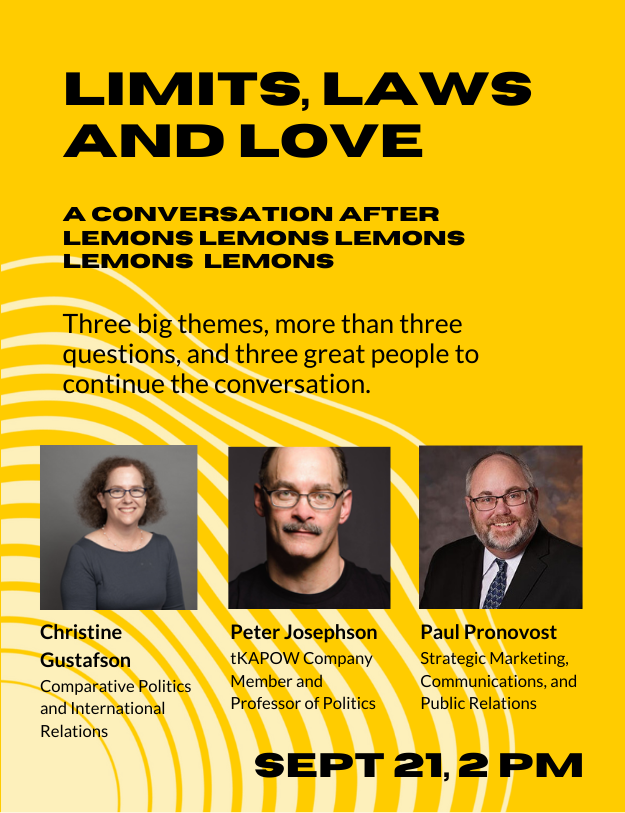
Limits, Laws and Love

Limits, Laws and Love

Join us for a conversation after the 2 pm matinee on Sunday, Sept 21.

Three big themes, more than three questions, and three great people to continue the conversation.

Dr. Christine Gustafson, Professor of Politics and Paul Pronovost, Vice President of Strategic Marketing, Communications, and Public Relations at Saint Anselm College will respond to the themes presented in the play.  tKAPOW company member Peter Josephson, also a Professor of Politics at St. Anselm College will facilitate the discussion.

Share your thoughts on the story and ask questions of our speakers and artists from the production.  Questions and answers will not be limited to 140 words. 😉

Dr. Christine Gustafson is a Professor of Politics at Saint Anselm College. She holds a Ph.D. and M.A. in political science from Brown University, as well as a master’s degree in international relations from the University of Southern California. She joined the Saint Anselm College Politics faculty in 2004, where she teaches courses in international relations, comparative politics, Latin American politics, and African Politics. She also teaches in the College’s Humanities and Honors programs. Her areas of research include Brazilian political economy, and the politics of religion and democracy. Her most recent work is a co-edited volume (with Alynna Lyon and Paul Manuel), entitled Pope Francis: Theology & Global Politics in the 21st Century, which is expected to be published early next year by Palgrave Macmillan. Dr. Gustafson is also a proud Board Member at the New Hampshire Humanities Council.

Paul Pronovost is the Vice President of Strategic Marketing, Communications, and Public Relations at Saint Anselm College, responsible for the branding and image of the nationally ranked Catholic and Benedictine liberal arts college. Prior to his time at Saint Anselm, Paul was the Executive Editor and General Manager of the award-winning Cape Cod Media Group and an adjunct professor of journalism at Emerson College. During his leadership, the Cape Cod Times was named New England’s Newspaper of the Year 10 times and national Newspaper of the Year twice. In 2016, he was named national Editor of the Year and in 2025 he was named to the New England Journalism Hall of Fame. A former Saint Anselm Crier editor, Paul holds a Bachelor of Arts in English from Saint Anselm College and a Master in Public Administration from Suffolk University. He has judged the Pulitzer Prize four times.

Q&A with Cast Members of The Best We Could (a family tragedy) by Emily Feldman

Q&A with Cast Members of The Best We Could (a family tragedy) by Emily Feldman

The third and final Mainstage Production of theatre KAPOW’s 17th season is just a week away! The Best We Could (a family tragedy) by Emily Feldman continues our theme of Conversation as we ride along with Lou and Ella, father and daughter, as they drive across the country to pick up Lou’s new dog. Guided by a narrator called Maps and interspersed with memories and phone calls from Ella’s mother, Peg, their journey reveals hard truths as their pasts slowly rise to the surface. Theatre KAPOW’s production of this debut play is it’s New Hampshire Premiere. 

Actors Alex Picard (Peg) and Samantha Griffin (Maps), both making their tKAPOW Mainstage debuts, shared some insight into the rehearsal process and the play. 

Q: Are there particular themes in the play that resonate deeply with you? What can you not get enough of exploring in the rehearsal room? 

Alex Picard (AP): The idea that we are all just doing the best we can is something I think we can all find some resonance with. We’re pulled in so many directions – work, home, family and friends that it’s difficult even to find time to ourselves nevermind to take care of ourselves. That’s something I hear in my head every day.  I’m doing the best I can.  Sometimes we are.  Sometimes we’re not.  But in the end it’s all we can do.  

Samantha Griffin (SG): Something especially exciting we get to explore in the room is the transfer of knowledge through time, and as this play is presented non-linearly, it’s really interesting to track when people find things out, and how that affects conversations when the audience still doesn’t have all the information. 

Q: What role does movement and physical exploration play in the rehearsal room and in the production?

SG: theatre KAPOW in general always makes a point of playing with physicality and movement, even in pieces that aren’t scripted to include those elements. We always start rehearsal with a physical activity or game, and that helps inform us as actors that it’s okay to use movement and explore throughout the rehearsal. 

AP: Movement and physical exploration has been critical in the development of the world of the play, characters, and how they physically relate to each other. I love working physically with character and finding the things that make Peg, Peg helps me to lean into her and her family more effectively as everyone in the cast is working similarly. We never leave the performance, though we do leave the scene and finding how we relate to the action as well as our need to move to the next place/person/moment is the bulk of our work. 

Q: Has your experience working on this play or collaborating with theatre KAPOW offered anything distinctive compared to your previous work as an actor?

SG: I’m always struck by how collaborative the room is when working with tKAPOW. There are the designated roles of director, stage manager, and actor, but in a lot of ways we are all contributing to the overall picture of the piece. In this play especially, I think there are moments where each of us could say “that came from me”, and that’s really special. KAPOW’s model is pretty rare, especially in NH, and I think that’s part of what makes their work so unique. 

AP: I’ve worked a lot in a lot of different places and one thing I see at KAPOW that I didn’t always see in other theatres or with other companies is the careful attention they pay to the emotional, physical, and mental wellness of their cast and crew.  It’s deeply appreciated. I feel cared for on and off stage. 

Q: Is there anything else you’d like to share about this play or process?

AP: I love how Emily Feldman built this world.  It’s structurally very interesting and her use of repetition is very powerful. Her characters are flawed and human and try so hard. Sometimes they gain ground, but more often than not, they’re just working with everything they’ve got not to slide back instead. 

SG: Life has both light and dark, and so does this play. I hope you can join us in finding the beauty and humanity in each. 

—-

THE BEST WE COULD (A FAMILY TRAGEDY) BY EMILY FELDMAN performs at BNH Stage in Concord June 13-15th. Tickets are available online now!: https://ccanh.my.salesforce-sites.com/ticket/#/events/a0SUT000000HOqj2AG

ARTiculate: Bauer by Lauren Gunderson

ARTiculate: Bauer by Lauren Gunderson

Bauer by Lauren Gunderson 

Rudolf Bauer…………………………………………………………………Michael Cobb
Louise Bauer ……………………………………………………Rachael Chapin Longo
Hilla Rebay………………………………………………………Deirdre Hickok Bridge
Directed by…………………………………………………………………..Carey Cahoon

Setting: The abandoned art studio in Bauer’s massive beachfront mansion in Deal, New Jersey. 1953, January

Read in conjunction with the Currier Museum of Art’s special exhibition Nicolas Party and Surrealism: An Artist’s Take on the Movement

Bauer is presented by arrangement with Broadway Licensing, LLC, servicing the Dramatists Play Service collection. (www.dramatists.com)  Bauer was commissioned and first produced by San Francisco Playhouse with the support of Rowland Weinstein. 

Deirdre Hickok Bridge (Hilla Rebay) is honored to be included as part of this reading at the Currier. Her previous theatre KAPOW productions include Life Sucks. (Babs), Paradise Now! (Laurie), Dance Nation (Sofia), Mr. Burns, a Post-Electric Play (ensemble), Stupid F%cking Bird (Emma), and Burial at Thebes (Eurydice), as well as tkapow’s 24 HR Play Festival. She is particularly proud of her 2019 performance in the titular role of Bo-Nita: a Play for One Woman at the Hatbox Theatre, which she also co-produced. Deirdre also has a background in textiles and apparel. She lives in Derry with her husband John, their children, and the dog. 

Michael Cobb (Rudolf Bauer) has played leading and featured roles for Trinity Repertory Company (company member), Dallas Theatre Center, and for David Gordon/PickUp Performance Company for PBS Alive TV and at the Public Theater, among many others. As an educator he has served as full-time faculty and coach at the National Theatre Conservatory/Denver Center Theatre, University of Minnesota/Guthrie Theater, and the Universities of Wisconsin and Utah.

Rachael Chapin Longo (Louise Bauer) is a theater maker, educator and arts advocate in the Boston area. She serves as a Board/Company member of theatre KAPOW and has been performing and directing with the company since 2013. Recent performances include “Pickles” in Life Sucks., Logan in The Thanksgiving Play, and Beth/Mother in Breadcrumbs. Rachael is a big fan of Lauren Gunderson’s work and is thrilled to be reading the part of Louise in Bauer as part of the Articulate Series.

Carey Cahoon (Director) was seen on stage this season with tKAPOW in Every Brilliant Thing, and last season in On the Exhale and as Alex in Paradise Now!. The ARTiculate play reading series at the Currier is one of her favorite programs theatre KAPOW does and she looks forward to reading scripts and planning for next year.

Lauren Gunderson (Playwright) is a playwright, screenwriter and short story author from Atlanta, GA. She received her BA in English/Creative Writing at Emory University, and her MFA in Dramatic Writing at NYU Tisch, where she was also a Reynolds Fellow in Social Entrepreneurship. She has been one of the most produced playwrights in America (American Theatre Magazine) since 2015, topping the list thrice including 22/23. tKAPOW produced her plays Silent Sky in 2019 and Natural Shocks in 2020.

theatre KAPOW, now in its seventeenth season, puts stories on stage to inspire healing conversations. tKAPOW has won the NH Theatre Award for Best Production of a Play four times: The Penelopiad by Margaret Atwood, Penelope by Enda Walsh, Time Stands Still by Donald Margulies, and Exit the King by Eugene Ionesco. In 2021, tKAPOW was honored with a Silver Lining Resilience Governor’s Arts Award for creative and innovative solutions offsetting challenges brought about by the COVID-19 pandemic. theatre KAPOW is supported by the New Hampshire Dance Collaborative, the New Hampshire State Council on the Arts, and the National Endowment for the Arts.

I, Will by Scott Carter

I, Will by Scott Carter

Statheatre KAPOW
and the Gregory J. Grappone Humanities Institute
at Saint Anselm College present

I, Will
A late romance
by Scott Carter

Dick / Jupiter / “Pericles” ……………………………………………….…. Matt Cahoon
Bobby / Cupid / “Marina #2” ……………………………………..…….. Glenn Provost
George / Harold ………………………………………………………….. Aaron Compagna
Will / “Chorus” …………………………………………………..………. Nicholas Meunier
Luce / Venus ………………………………………………………….……….. Amy Agostino
Mountjoy……………………………………………………………………… Peter Josephson
Ghost Marie / Diana………………………………………..…………Courtney St. Gelais
Mary………………………………………………………………………… Samantha Griffin
Stephen ………………………………………………………………………………. Kelly Litt
Director ……………………………………………………………………….. Carey Cahoon

Setting: 1608-9, London

Amy Agostino (Luce/Venus) is delighted to be part of this reading of I, Will; bringing a new work to life is always a special thrill! Prior projects with theatre KAPOW include Desdemona and As It Is In Heaven. She’d like to thank Carey for the opportunity to come out and play with some of her favorite artists.

Matt Cahoon (Dick/Jupiter/Pericles) is a theatre maker who specializes in Direction and Production Design. He is one of the co-founders of theatre KAPOW and during his time with tKAPOW, Matt has directed over 30 productions for the company.

Aaron Compagna (George/Harold) is glad to return to theatre KAPOW for this play reading. He was last seen with tKAPOW in The Illusion by Tony Kusher, and several ARTiculate play readings 

Samantha Griffin, she/her, @samdgrif, (Mary) is a theatre artist and double virgo from Southern New Hampshire. Favorite credits include A MIDSUMMER NIGHT’S DREAM (theatre KAPOW), SEUSSICAL! THE MUSICAL (Firehouse Center for the Arts), and SUNDAY IN THE PARK WITH GEORGE (Columbia College Chicago). She holds a BFA in Musical Theatre Performance with a minor in Playwriting from Columbia College Chicago. Next up: THE BEST WE COULD  (theatre KAPOW)

Peter Josephson (Mountjoy) is in his fourteenth season as a company member of tKAPOW. An accomplished actor and director, he has been nominated for Seacoast Spotlight awards for both acting and directing, and has won two New Hampshire Theatre Awards for his roles in Penelope and Exit the King (both with tKAPOW). He was last seen this season as Aster in Life Sucks. and in Every Brilliant Thing.

Kelly Litt (Stephen) is a New England-based actor and musician. He trained in Liverpool, England before moving to New York where he worked in theatre and radio. He is now back in NH and excited to be working again with tKAPOW.

Nicholas Meunier (Will)  is thrilled to be back with theatre KAPOW for this exciting project. Previous credits with tKAPOW include Pride & Prejudice and Mr. Wolf. He is a deep lover of Shakespeare and is a founding member of The World’s A Stage Players, the resident Shakespeare troupe of the Concord (MA) Players. He has performed or directed 20 Shakespeare productions, covering 16 of his plays (including Pericles!). 

Glenn Provost (Bobby/Cupid/Marina #2) was last seen on stage with tKAPOW this season in Life Sucks. He is an award-winning actor and a less distinguished director, producer, designer, improvisor, and one-time playwright. His favorite roles include M in Lungs, Ben in Seascape with Sharks and Dancer, Guildenstern in the Hamlet / R+G Are Dead Project, Vladimir in Waiting for Godot, and both Orpheus and the Nasty, Interesting Man in two different productions of Eurydice.

Courtney St. Gelais (Ghost Marie/Diana) was last seen on stage with tKAPOW as Oberon/Theseus in A Midsummer Night’s Dream.

Carey Cahoon (Director/Stage Directions) was seen on stage this season with tKAPOW in Every Brilliant Thing, and last season in On the Exhale and as Alex in Paradise Now!. She is pleased to be back at St. A’s to celebrate the Bard with a reading of this new play.

Scott Carter (Playwright) is Executive Producer / Co-creator of Regional Emmy winning talk show LOVE & RESPECT WITH KILLER MIKE (PBS / REVOLT TV). He was nominated for dozens of Primetime Emmys as Executive Producer / Writer of the first 1,100 episodes of POLITICALLY INCORRECT (Comedy Central, ABC) and the first 16 seasons of REAL TIME WITH BILL MAHER (HBO), for which he won Producers Guild of America and Writers Guild of America awards.  Carter has created and produced talk shows for Lewis Black (Comedy Central), Candice Bergen (Oxygen Media), Kevin Nealon (Spike TV), and most recently, Bob Costas (HBO). In 2024, Scott was asked to speak at TEDx ASBURY PARK conference in New Jersey. His TEDx talk Indivisible is available on youtube. His play THE GOSPEL ACCORDING TO JEFFERSON, DICKENS AND TOLSTOY: DISCORD has been produced in 26 cities in four countries.


“I’m going to ask you to be…”: Every Brilliant Thing, from the Audience’s Perspective

“I’m going to ask you to be…”: Every Brilliant Thing, from the Audience’s Perspective

theatre KAPOW has always aimed to bring the audience as close to the action as possible. In the company’s 17 year history, no play has ever done that quite like Every Brilliant Thing, which entirely relies on the audience to tell the story, inviting audience members to use their bodies and their voices to contribute to the play itself.

Longtime audience member and friend of tKAPOW, Eric Gutterson, has been visiting the Every Brilliant Thing rehearsal room throughout the process to play “test audience” and help the company experiment with the play’s audience participation. Eric provided some insight about this experience, and about what makes Every Brilliant Thing particularly special. Read Eric’s thoughts on the play and process below:

Q: How is the audience experience for Every Brilliant Thing unique from other plays?  

A: The obvious answer is that the audience can be more involved- become a part of the story. Being involved as an audience member might only be expected at an event like a magic show, illusionist, hypnotist, etc. The typical expectation as an audience member at a play is that you attend, find your seat, watch the show from a third-person perspective, and that is the full scope of the experience. Every Brilliant Thing welcomes willing participants into the story. One audience member might recite a Brilliant Thing out of a list of very many things. Or to a greater extent, one might take on a character, a person in the narrator’s life. The relationship with the actor is more intimate – they see you, they listen to what you have to say, and the interaction becomes part of the show.

Q: What feelings does the play evoke for you as an audience member?

A: Laughter, sadness, joy, longing, and a sense of togetherness. There is a sense of community between the actor, audience, and everyone in the building. Also, the play doesn’t shy away from being real. There are dark tones, but you come up for air early and often with frequent moments of comic relief.

Q: What has your experience been like in the rehearsal process and being a part of helping the team develop the piece? 

A: The rehearsal process has been a lot of fun. It has required careful consideration and respect for the audience, and for the level of engagement each individual might be comfortable with on show night. It feels like each moment is tailored with this in mind. The actor is faced with a constant challenge of not knowing what an audience member might do. When being a “guest audience member”, my goal has been to present several possible audience responses, sometimes ordinary, sometimes a little crazy. The play requires keen improvisation from the actor, which might be my favorite thing ever, because it can bring about hilarious, unexpected, unique scenarios that you’ll only experience once. I’m excited to see how it all comes together.

—

EVERY BRILLIANT THING
By Duncan Macmillan with Jonny Donahoe

February 7-9, 2025
BNH Stage in Concord, NH

February 21-23rd, 2025
Winnipesaukee Playhouse in Meredith, NH

Tickets & more information: www.tkapow.com/productions/#brilliant

*ASL Interpretation will be available on 2/9. 

**Live music by local musicians begins 30 minutes prior to each performance. 

#image_title
Skip to content